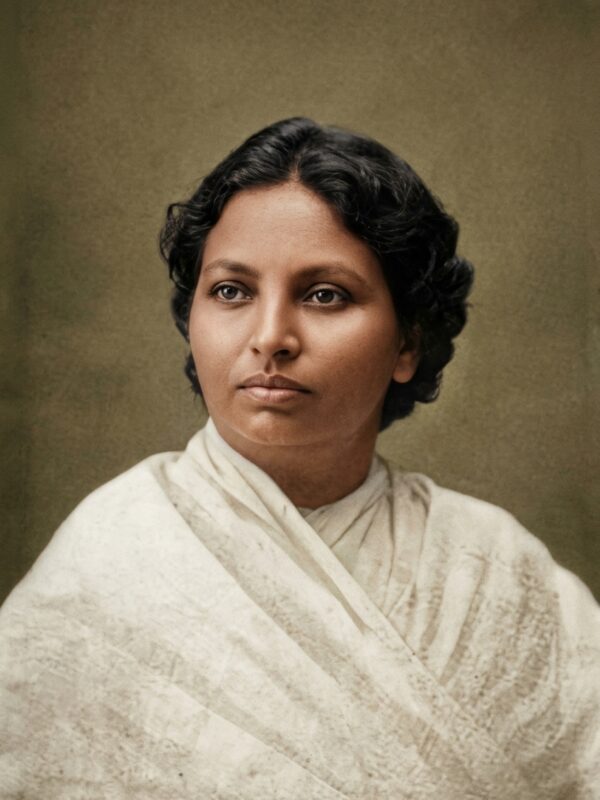
Pandita Ramabai: What Following Christ Looked Like
Ramabai Dongre was born on 23 April 1858 into a Brahmin family in Maharashtra, India. Her father, Anant Shastri Dongre, was a Sanskrit scholar who did something rare and controversial: he taught his wife and daughter to read and study the scriptures. Orthodox Brahmins opposed this. He did it anyway.
It did not shield the family from what was coming. In the great famine of 1876 to 1878, her parents and a sister died. Ramabai and her brother walked across India, two young people with no home and no income, reciting Sanskrit texts at pilgrimage sites for whatever coins came their way. By the time she reached Calcutta, she had walked thousands of miles and lost nearly everyone she loved. The scholars at Calcutta University invited her to speak. They gave her the title Pandita, meaning learned one. She was twenty years old.
She married a Bengali lawyer named Bipin Medhvi in 1880, crossing caste and regional lines in a civil ceremony. Their daughter Manorama was born the following year. In 1882, Medhvi died of cholera. She was twenty-three. A widow with a baby daughter, without caste standing, without a home community to return to.
She had already been reading. She testified that year before the British Hunter Commission on education, telling them plainly that educated Indian men were overwhelmingly opposed to women’s education. She began asking what a religion built on texts she could now read actually offered to women. She was not finding satisfying answers.
In England in 1883 she found a copy of the Gospel of Luke. She worked through it and then through the Gospel of John. In John 4, the story of Jesus and the Samaritan woman at the well, she said she found what she was looking for: a God who crossed social boundaries to reach the outcast. She was baptised in England and returned to India as a Christian. This cost her. It cost her the support of Hindu reformers who had backed her work. It cost her standing among the people who might otherwise have been her allies.
In 1889 she founded Sharada Sadan, a school for child widows in Pune. In India at the time, a girl widowed before she reached adulthood could not remarry. Many were sent away from their husband’s family. Many ended up at pilgrimage sites, destitute. Many were trafficked. Ramabai knew this. When several of her students became Christians, Hindu reform circles withdrew their support. She moved the school to Kedgaon, renamed it Mukti Mission, and kept working.
In 1895 she disguised herself as a female mendicant and went into pilgrimage sites to find women who had been abandoned there. The first attempt nearly cost her life. She came back. During the famine of 1896 she drove bullock carts through Maharashtra and pulled starving girls and women out of conditions her contemporaries described as worse than those of a stray dog. She brought them to Kedgaon. By 1900, more than 1,500 people lived at Mukti. Ramabai’s residents dug wells, cleared a hundred acres of barren land, built housing and schools from almost nothing.
In June 1905, revival broke out. Ramabai had been praying with a group of women for months, asking God to move. When it came, she did not display it. She tested it. If a girl seemed to be imitating others without genuinely calling on Christ, Ramabai would stop her. She then sent the revived women out in bands to evangelise nearby towns and villages. The Mukti Revival spread across India, to schools and mission homes in Poona, Dhond, Allahabad, and Bangalore. Scholars note that it preceded the Azusa Street Revival of 1906.
She spent her last years on a Bible translation. She had the whole text of the Old and New Testament translated into Marathi from the original Hebrew and Greek, not from an English version. She finished the manuscript in 1922. She died on 5 April 1922, aged 63. Her daughter Manorama, who had been her successor, had died the year before.
The Government of India issued a postage stamp in her honour in 1989. Mukti Mission continues to operate in Kedgaon.
She was not a saint without fault. She rejected the doctrine of the Trinity for a time. She disagreed with the Western missionaries who came to study her revival. She was a complicated woman with strong views. But she read the Gospels and took them seriously, and the record of what she built is what that looked like.
She was hungry for something better. She found it. And she spent the rest of her life making sure others could too.