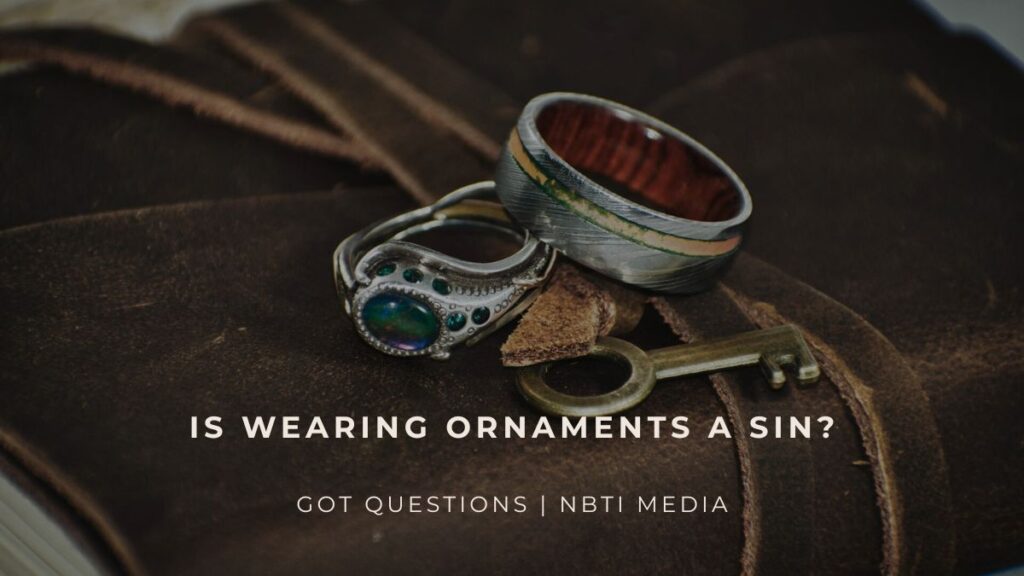
The question of whether wearing ornaments is sinful has been a subject of discussion and division in many Christian communities. Some churches forbid all forms of jewelry, labeling it as worldly or vain, while others permit it in moderation. To navigate this topic with biblical clarity, we must distinguish doctrine from dogma as well, and consider the intent of Scripture—not just its surface.
Doctrine vs Dogma:
Before diving into the biblical text, it’s essential to define two important terms:
- Doctrine refers to core teachings of the Christian faith, grounded in Scripture and central to salvation (e.g., the divinity of Christ, resurrection, grace through faith).
- Dogma, in contrast, often refers to authoritative rules or customs that develop over time within specific denominations or traditions. These are not necessarily wrong, but they are not always rooted directly in Scripture and can sometimes be elevated beyond their place.
The debate over ornaments is often more dogmatic than doctrinal. That is, it’s frequently based on denominational standards rather than direct biblical commandments.
1. Ornaments in the Old Testament:
Ornaments were common among God’s people in the Old Testament, and in many cases, even seen as signs of favor and blessing.
- Genesis 24:22, 30, 53 – Rebekah was given a nose ring and bracelets as part of a divinely orchestrated marriage arrangement.
- Exodus 3:22; 12:35-36 – The Israelites were instructed to take silver, gold, and clothing from the Egyptians—gifts that were not condemned but facilitated their freedom.
- Ezekiel 16:10–13 – God poetically describes Israel as His bride, clothed with fine linen and adorned with jewelry: “I adorned you with ornaments, put bracelets on your wrists, and a chain on your neck.”
Key Insight
Ornaments themselves are not condemned in the Old Testament. Rather, they are portrayed as expressions of blessing, beauty, and covenantal favor.
2. When Ornaments Were Removed: Context Matters
There are moments in Scripture where God’s people were told to remove ornaments, but the reason behind it is key.
- Exodus 33:4-6 – After the sin of the golden calf, the Israelites removed their ornaments as an act of repentance and humility before God.
- Isaiah 3:16–24 – God warns the women of Zion who are obsessed with appearance. The judgment is not on jewelry alone but on their pride, vanity, and spiritual apathy.
Key Insight
Ornaments were laid aside during seasons of repentance or judgment, not because they were inherently sinful, but because God was calling His people to refocus their hearts. To avoid glorifying the ornaments rather than the Creator.
3. New Testament: Focus on Modesty and the Heart
In the New Testament, the emphasis shifts from the external to the internal. Adornment is not forbidden, but the attitude behind it is addressed.
- 1 Peter 3:3-4 – “Do not let your adornment be merely outward—arranging the hair, wearing gold, or putting on fine apparel—but rather let it be the hidden person of the heart…”
- 1 Timothy 2:9-10 – “…women adorn themselves in modest apparel, with propriety… not with braided hair or gold or pearls… but with good works.”
Key Insight
The apostles weren’t banning jewelry, but challenging the misuse of adornment as a substitute for godliness. They point us to modesty, humility, and good works as the real Christian beauty.
4. The Heart of the Matter: Principle Over Appearance
The Bible consistently teaches that God looks at the heart (1 Samuel 16:7). Thus, we are called to evaluate:
- Motivation – Am I wearing this to glorify God or to elevate self?
- Modesty – Does it draw attention to me or reflect humility?
- Maturity – Will this cause another believer to stumble?
- Mission – Does my appearance help or hinder the gospel?
The answer to whether something is a sin lies not just in the act, but in the attitude and consequence of that act.
5. Is Wearing Ornaments a Sin?
Biblically: No, it is not inherently a sin.
However, it can become sinful when:
- It reflects pride, materialism, or worldliness.
- It becomes a stumbling block to others.
- It replaces or overshadows your devotion to Christ.
Just like food, clothing, or wealth—ornaments are neutral tools, but how you use them reveals your heart.
6. Final Thoughts: From Legalism to Liberty
Some churches have turned the issue of ornaments into a dogma, placing it on the same level as core doctrines like salvation by grace or the resurrection of Christ. This is where care must be taken not to add burdens that Scripture does not impose.
Paul warns in Colossians 2:20-23 against human commands that appear spiritual but are of “no value against the indulgence of the flesh.”
Let’s not turn personal convictions into universal commandments. Let each believer be guided by Scripture, the Holy Spirit, and a desire to glorify God in all things.