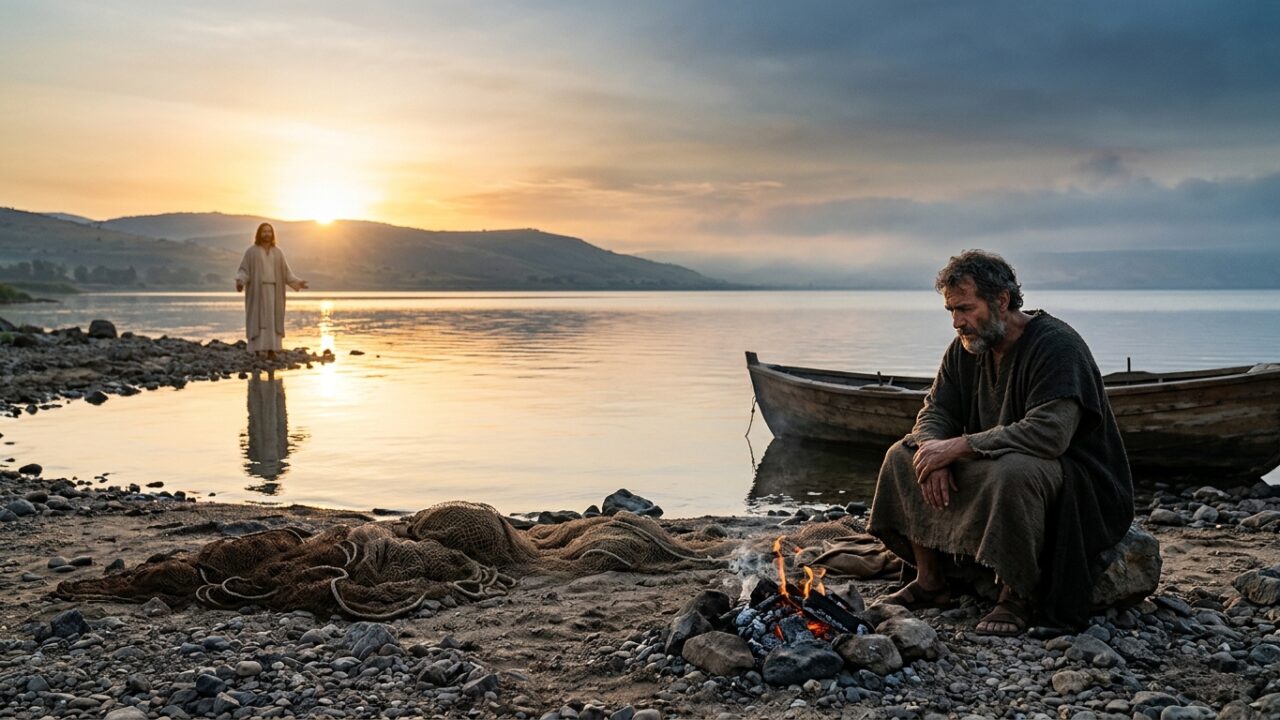
Some of the most painful moments in a believer’s life are not the moments when the world rejects us, but the moments when we feel we have disappointed the Lord who loved us unconditionally.
Peter, one of the strongest leaders in the New Testament church, knew that pain in depth.
He was not an outsider who never knew Jesus or was not someone who rejected Christ because he did not understand Him.
Peter walked with Jesus for three and a half years. He saw the blind receive sight, the lame walk, the dead raised, and storms silenced by the voice of his Master. He stood on the mountain of Transfiguration and witnessed the glory of Christ unveiled. He was one of the three disciples who was brought closer than the others in the Garden of Gethsemane, where Jesus wrestled in prayer before the cross.
Peter had seen enough to know who Jesus was. He had heard enough to know what Jesus had called him to do. Yet, on the night Jesus needed him most, Peter failed. The man who boldly declared, “Even if all are made to stumble because of You, I will never be made to stumble,” became the man who denied knowing Jesus three times.
But his story does not end beside a charcoal fire of denial; it ends beside another charcoal fire on the shore of Galilee.
And after asking Peter three times, “Do you love Me?” Jesus gave him an invitation that would echo back to the beginning of his journey: “Follow Me.” (John 21:19). Those two words had been spoken to Peter before.
Years earlier, while Peter was still a fisherman with empty nets and an unknown future, Jesus walked along the shore of Galilee and said: “Come, follow Me, and I will make you fishers of men.” (Matthew 4:19)
The First Call (Matthew 4:19)
“Come, follow Me, and I will make you fishers of men.”
Matthew records Jesus’ words as Δεῦτε ὀπίσω μου (Deute opisō mou), meaning ‘come after Me.’ The word Deute has a warmth of personal invitation more than a command. Peter contributed nothing except his willingness to leave his belongings and follow Jesus. The phrase opisō mou means ‘behind Me.’ In Jewish discipleship, students physically walked behind their Rabbi. So, Jesus was not inviting Peter merely to believe certain doctrines; instead, He was inviting Peter into an entirely new way of life.
The Second Call (John 21:19)
After restoring Peter’s love and responsibility, Jesus speaks about Peter’s future (John 21:18), and then Jesus says, “Follow Me.” John records Jesus’ words ἀκολούθει μοι (akolouthei moi), meaning to accompany, or to follow as a disciple. But there is something significant about the grammatical structure. This is a present imperative usage which often communicates continuous action.
Jesus is not commanding Peter, “Start following.” Peter already started following three and a half years earlier. Jesus is saying, “Continue following,” “keep walking with Me,” “remain faithful to Me,” “do not stop when the road becomes difficult.” The command assumes a journey already begun.
The Difference
The first call was about beginning discipleship. The second call was about finishing faithfully.
The journey had moved from leaving nets to carrying a cross; learning from Jesus to suffering for Christ; serving Jesus to glorifying Christ.
Peter’s restoration reveals something profound about the heart of Christ. Jesus did not restore Peter because Peter had finally become strong enough, faithful enough, or worthy enough to serve Him. Jesus restored Peter because His grace was greater than Peter’s failure.
Peter learned what Jesus had always taught: following Christ is not merely about walking with Him when the road is comfortable. It is about surrendering to Him when the road leads to sacrifice.
Peter’s life also reminds us that true discipleship is not accomplished through human strength or determination. The same Peter who once failed because he trusted in his own courage later stood faithfully because he depended on the power of the Holy Spirit. Restoration did not merely bring Peter back to where he was; it transformed him into the man Christ called him to become. The grace that forgave Peter was the same grace that strengthened Peter to remain faithful until the end.
Jesus had already spoken these words: “If anyone desires to come after Me, let him deny himself, and take up his cross, and follow Me.” Matthew 16:24
The question remains: Are you ready to take up your cross and follow Christ?
The call to follow Christ is not a call to walk in our own strength, but a call to surrender our lives to the One who has already given Himself for us. The same Saviour who restored Peter is the Saviour who empowers His people to follow Him faithfully until the day we see Him face to face.
