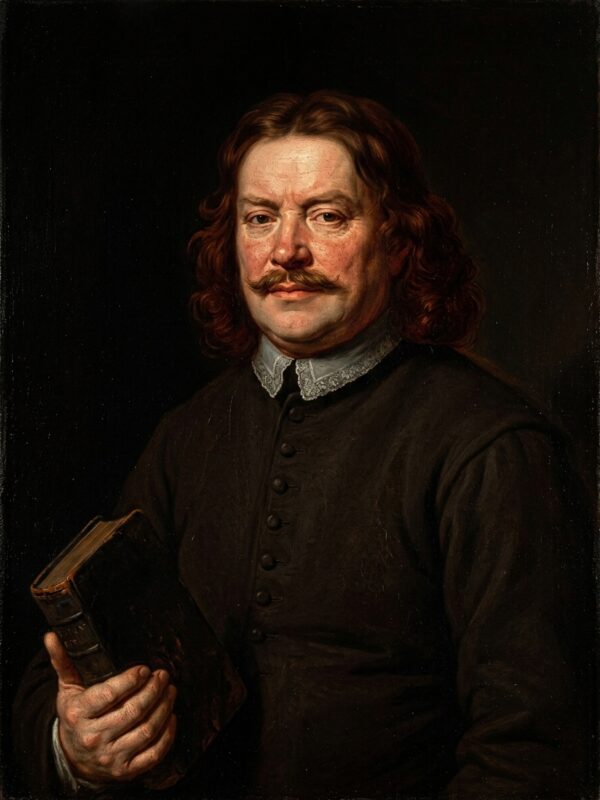
John Bunyan: What a Prison Cell Produced
He was a tinker. That is what he was. A man who mended pots and pans for a living in the town of Bedford, England, in the 17th century. He had almost no formal education. He had no wealth, no connections, no social standing of any kind.
And he wrote the most widely read Christian book in history, apart from the Bible itself.
John Bunyan was born in 1628 in the village of Elstow, just outside Bedford. His early years were, by his own account, wild and ungodly. He swore. He rang the church bells for sport. He played sports on Sundays without a second thought. He was not the kind of young man anyone was watching for greatness.
But in his early twenties, after his first wife died and left him with four children – including a daughter who was blind – Bunyan began to read seriously. He read the Bible. He read Martin Luther. Something happened inside him that he later described in agonizing detail in his autobiography, Grace Abounding to the Chief of Sinners. A long, dark, painful awakening that eventually brought him to a living faith.
He began to preach. And he was extraordinarily good at it.
The problem was that in Restoration England, you needed a license to preach, issued by the Church of England. Bunyan was a Nonconformist. He did not have a license, and he refused to get one. He was arrested in 1660 and offered a simple deal: stop preaching and go free. He refused. He was locked in Bedford jail.
He spent twelve years there.
His wife Mary pleaded before the judges on his behalf. His daughter Elizabeth, still a teenager, walked into court and argued for her father. The judges were unmoved.
In that cell, with a few books and his Bible, Bunyan began to write. He wrote Grace Abounding. He wrote theological treatises. He wrote pamphlets. And he began to write an allegory about a man named Christian who sets out from the City of Destruction on a journey to the Celestial City.
The Pilgrim’s Progress was published in 1678, after Bunyan was finally released. Within a year it had gone through three editions. It has never gone out of print since. It has been translated into over 200 languages. More copies have been produced than any book in English except the Bible.
He was released from prison eventually, preached for another twelve years, and died in 1688 of a fever caught while riding in the rain on the way to reconcile a father and son who had fallen out.
That was John Bunyan. Dying on the way to help somebody.
He did not write the Pilgrim’s Progress because his life was easy. He wrote it because he knew what it was to be on the road, in the dark, carrying something heavy, and still moving forward. He wrote it for the rest of us.