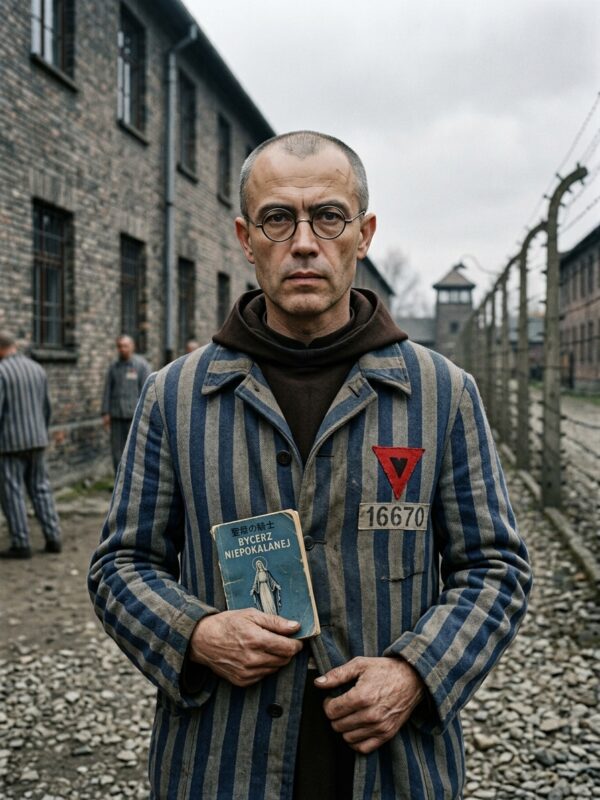
Maximilian Kolbe: Take Me Instead
On July 29, 1941, at Auschwitz concentration camp, the commandant ordered the inmates to assemble. Three prisoners appeared to have escaped, and the policy was brutal: ten men would be chosen at random to be locked in the starvation bunker as punishment. They would receive no food and no water until they were dead.
The commandant pointed. One man. Then another. Then another.
When the tenth man was selected, the prisoner cried out: My wife! My children!
A man stepped out of the lineup.
He was a small man, thin from the camp diet, wearing round wire-framed spectacles. He said: I am a Catholic priest. I am older. I would like to take his place.
The commandant looked at him for a long moment. Then he accepted.
The man whose life was just traded was Franciszek Gajowniczek. The man who stepped forward was Father Maximilian Maria Kolbe. He was 47 years old. He had never met Franciszek before in his life.
Maximilian Kolbe was born in 1894 in Zdunska Wola, Poland, the son of a deeply devout family. He joined the Franciscan order at 16. He was ordained as a priest in 1918. And what he built in the years that followed is almost too extraordinary to summarize.
He founded Niepokalanow – the City of the Immaculate – near Warsaw, a monastery that became the largest friary in the world, with over 800 friars. He launched a magazine that reached a million readers every month, printed by monks on donated equipment in a field outside Warsaw. In 1930 he travelled to Nagasaki, Japan, with four other friars who spoke no Japanese and had no money. Within one month they had published a magazine in Japanese. He built a monastery on a hillside outside the city. When the atomic bomb fell on Nagasaki in 1945, that monastery survived essentially unharmed. It functions to this day.
When the German army invaded Poland in 1939, Kolbe turned Niepokalanow into a refugee camp that sheltered approximately 3,000 people, roughly 2,000 of them Jewish. He was arrested twice. The second time, on February 17, 1941, the Gestapo came to Niepokalanow. He was still at his desk finishing notes for a book. He put down his pen, walked out calmly, and was sent to Auschwitz.
He continued his ministry in the camp in secret. He heard confessions at night in the barracks. He shared his food rations. Guards beat him for it. He kept going.
And then came July 29.
In the starvation bunker, Kolbe did not despair. The guards reported that instead of the screaming and weeping that usually came from that cell, they heard singing. He organized the dying men into prayer and hymns. He outlasted the other nine by days. On August 14, 1941, guards entered the cell to clear it. Kolbe was the last one still alive. They killed him with a lethal injection of carbolic acid.
He was 47 years old.
Pope John Paul II canonized him on October 10, 1982. Franciszek Gajowniczek, the man whose place he had taken, attended the ceremony in Rome. He was 81 years old. He lived to age 93.
When asked about that day in the prison yard, Gajowniczek said: I could only thank him with my eyes. I was stunned and could hardly grasp what was going on.
He was not assigned to martyrdom. He chose it. Standing in a prison yard in Poland, on an ordinary Tuesday, he chose it. And he chose it for a man he had never spoken to.