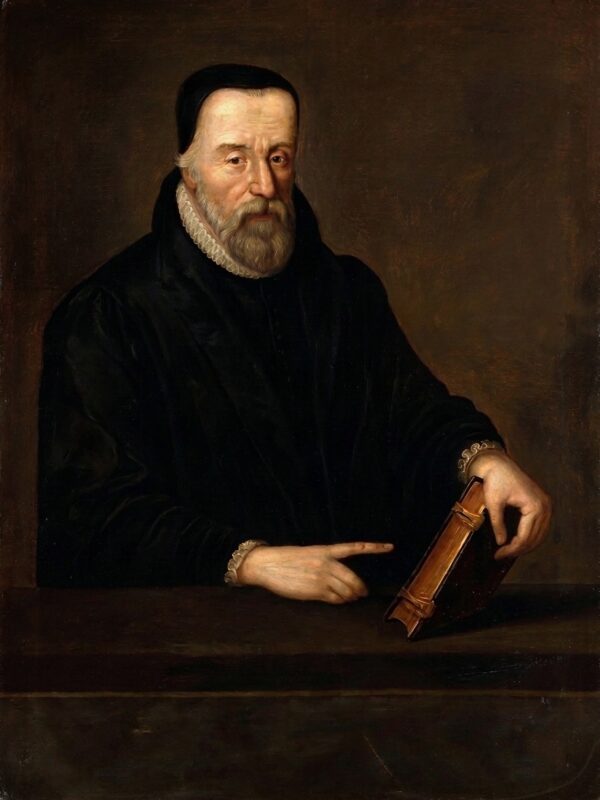
William Tyndale: The Boy Driving the Plough
William Tyndale was born around 1494 in Gloucestershire, in the west of England. He was educated at Oxford and Cambridge, and by the time he was in his twenties he could read Scripture in Greek, Hebrew, Latin, German, Italian, Spanish, and English. He was, by any measure, one of the most gifted linguists in England. He was also convinced that the boy driving a plough in a field had the same right to read the words of Jesus as any bishop in his palace.
That conviction was not safe to hold.
In 1516, Erasmus published his Greek New Testament. Tyndale read it and found, in the Greek itself, things the Latin Vulgate translation had obscured or lost. He was not looking for a fight. He found one anyway. When a learned man at a dinner told him that the Pope’s laws mattered more than God’s, Tyndale told him plainly: “If God spares my life, ere many years I will cause a boy that driveth the plough to know more of the Scripture than thou dost.”
In 1523 he went to London with a simple request: permission from the Bishop of London to translate the New Testament into English. The Bishop refused. No such permission existed to give. The Church held that Scripture in the vernacular was dangerous, that ordinary people could not be trusted with the unmediated word of God. Tyndale disagreed. He crossed the Channel in 1524 and never returned to England.
He worked in Hamburg, Cologne, Worms, and finally Antwerp. He was always moving, always hiding. Henry VIII’s agents tracked him across Europe. Thomas More called him a heretic. Wolsey pursued him. Through all of it, Tyndale kept his desk and his manuscripts. His New Testament, translated directly from the Greek, came off the press in Worms in 1526. It was the first English New Testament drawn from the original language. The Bishop of London purchased as many copies as he could find to burn them publicly at St Paul’s Cathedral. The money went straight back to Tyndale’s press. He used it to print a revised edition.
He kept working. He completed the Pentateuch and the book of Jonah from the Hebrew. He revised the New Testament three more times, refining the language, correcting errors, sharpening the translation. He had no church, no salary, no institution behind him. He was a fugitive scholar in rented rooms with a Hebrew lexicon and a conviction.
In 1535, a man named Henry Phillips arrived in Antwerp. He was charming, apparently in need of help, and over several months he won Tyndale’s trust. On 21 May 1535, Phillips pointed Tyndale out to waiting soldiers in an alleyway outside the house where he was staying. He was arrested and taken to Vilvorde Castle, sixteen miles north of Brussels. He was held there for sixteen months.
From prison, Tyndale wrote to the prison governor asking for a warmer coat for winter, a candle for the long dark evenings, and his Hebrew Bible, grammar, and dictionary. He was not done. He was condemned as a heretic in August 1536. On 6 October 1536, he was led out, strangled, and his body burned. He was forty-two years old. John Foxe records his last words as a prayer: “Lord, open the King of England’s eyes.”
Three years later, Henry VIII ordered an English Bible placed in every parish church in England. It was built almost entirely on Tyndale’s work. The Great Bible of 1539, the Geneva Bible, the Bishops’ Bible, and the King James Version of 1611 all trace their language back to him. Scholars estimate that 84 percent of the King James New Testament is Tyndale’s words. Phrases that have been in the English language so long we have forgotten they came from anywhere — “the salt of the earth,” “signs of the times,” “a law unto themselves,” “the powers that be,” “my brother’s keeper,” “filthy lucre,” “it came to pass” — Tyndale coined them, or fixed them in English, in the act of translating Scripture.
He was condemned as a heretic. The prayer attributed to his last breath was answered within three years. The Church that burned his Bibles became a Church that required them. He never saw any of it.
What he gave us was not just a translation. It was the vocabulary of the Gospel in English. He paid for it with his life, and we have been reading it ever since.