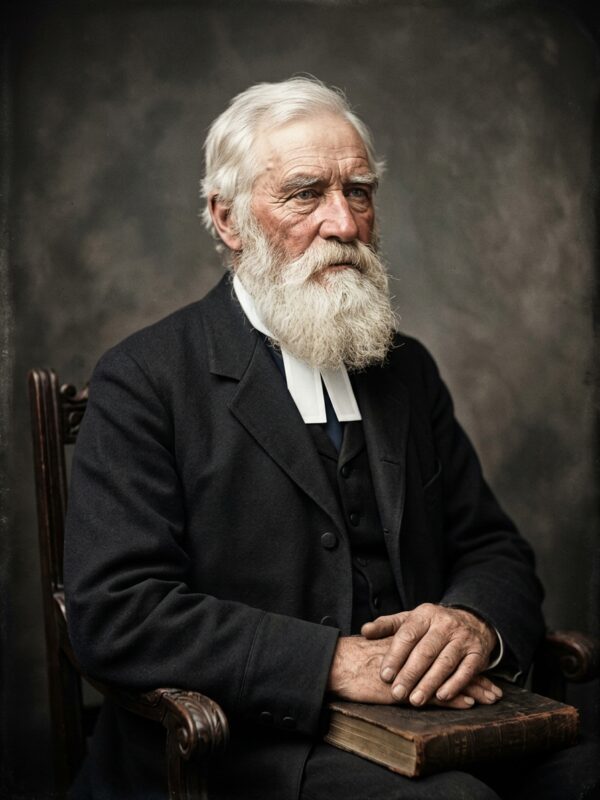
John Paton: He Stayed
When John Paton told his congregation in Glasgow that he was going to the New Hebrides as a missionary, an older minister stood up and said: You will be eaten by cannibals.
Paton replied that if he could but live and die serving and honoring the Lord Jesus, it would make no difference to him whether he was eaten by cannibals or by worms.
He was 34 years old and he had already given up a promising ministry in Glasgow to answer what he believed was an undeniable call.
John Gibson Paton was born in 1824 in a three-room cottage in Dumfriesshire, Scotland, the eldest of eleven children. His father James was a stocking-maker and a man of deep, daily prayer. John later said that watching his father pray behind the closed door of that small cottage shaped him more than any sermon he ever heard.
He arrived on the island of Tanna on November 5, 1858, with his young wife Mary. Two previous missionaries had been killed on the islands. On their first night on Tanna, they could hear a cannibal feast nearby. The next morning Paton went for water and found the spring fouled with blood.
Within four months, Mary Paton was dead of tropical fever. Their newborn son Peter died 17 days later. Paton dug both graves with his own hands and buried them beside the house he had built. He then stood guard over those graves at night to prevent the islanders from digging up the bodies. He later wrote: But for Jesus and the fellowship He gave me there, I must have gone mad and died beside that lonely grave.
He stayed on Tanna alone for four more years. He was driven off the island in 1862 when the tribal situation became too dangerous, and eventually moved to the smaller island of Aniwa.
On Aniwa, Paton announced he was going to dig a well. The islanders told him rain comes from above, not from the ground. They thought he had lost his mind. At 30 feet, Paton struck clean fresh water. The chief Namakei stood before the whole island and preached: Jehovah God has sent us rain from the earth. Why should He not also send us His Son from Heaven?
The idols were burned that week. The entire population of Aniwa came to faith.
Paton completed a translation of the New Testament into the Aniwan language. He founded schools and churches across the islands. By 1899 missionaries were established on 25 of the 30 islands of the New Hebrides.
He died in Australia in 1907 at age 82. His autobiography became a bestseller that inspired a generation of missionaries. It is still in print.
Today, roughly 85 percent of Vanuatu’s population identifies as Christian.
He went to a cannibal island, buried his family there, and the whole island turned to Christ. Some stories are so improbable that only God could have written them.