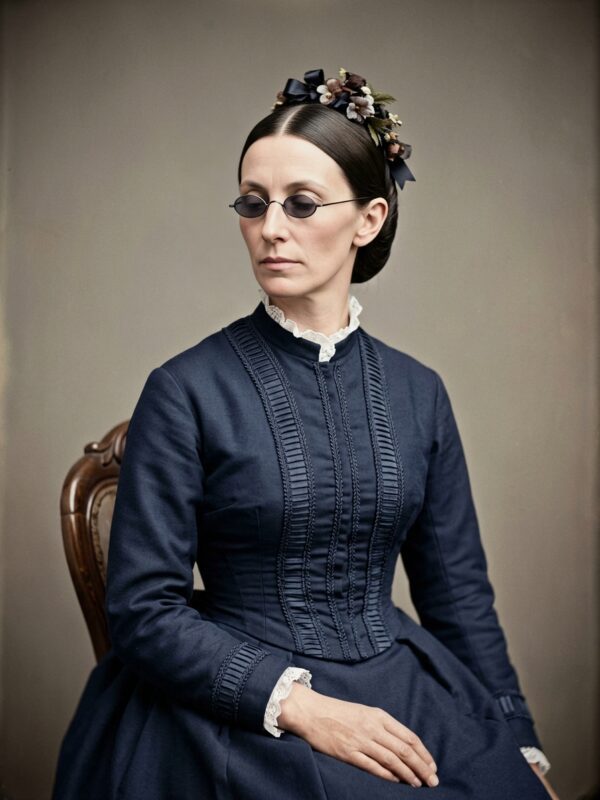
Fanny Crosby: She Could Not See What She Was Giving the Church
When Fanny Crosby was six weeks old, a local doctor put hot mustard poultices on her inflamed eyes. She was never meant to be blind. It was a mistake. A bad, irreversible mistake that took from her the ability to see for the rest of her nearly 95 years.
She said it was one of the best things God ever did for her.
Frances Jane Crosby was born on March 24, 1820, in Southeast, New York, into a devout Christian family. Her father died when she was just under a year old. Her mother went to work as a maid to survive. Her grandmother Eunice became the primary person who shaped her world.
Since Fanny could not read, her grandmother did what seemed impossible: she sat with her every day and taught her the entire Bible from memory. Psalm by psalm. Proverb by proverb. The Book of Ruth. The Gospels. Most of the New Testament. By the time Fanny was a teenager, she could recite vast stretches of Scripture without a mistake.
At 15 she entered the New York Institution for the Blind, where she spent nearly 20 years first as a student and then as a teacher. Her gift for poetry and verse became famous quickly. She addressed multiple sitting presidents. She read her poetry before the United States Senate Chamber, becoming the first woman ever to speak publicly there.
And then in 1850, at a revival meeting, at age 30, she finally gave everything to Christ. She stepped forward at the altar call, and by her own account, a joy flooded through her that she had never known before.
She went home and started writing hymns.
The output that followed across the next several decades was staggering. She wrote under more than 200 pseudonyms because publishers were embarrassed to have her name appear too many times in a single hymnal. By the time she died, she had written somewhere between 8,000 and 9,000 hymns. Nobody knows the exact number. She wrote so many that publishers lost count.
Blessed Assurance. To God Be the Glory. Rescue the Perishing. Pass Me Not. Safe in the Arms of Jesus. All the Way My Savior Leads Me. These are not minor contributions. These are the songs that have carried the church through its hardest centuries.
She wrote most of them on her knees, in prayer, before she dictated a single word.
Rescue the Perishing came out of a summer evening in 1869 at a mission in the Bowery district of New York. She felt an overwhelming impression that some mother’s son was in that room and needed to be reached that night or not at all. She made a public plea. An eighteen-year-old boy came forward in tears. He had promised his mother he would meet her in heaven. The way he was living, he said, that would be impossible. He was converted that night. Fanny went home and wrote the hymn.
She died on February 12, 1915, at age 94, in Bridgeport, Connecticut. Her funeral was the largest the city had ever seen. Her hymns are still sung on every continent.
She never saw a sunrise. She never saw a face. She never saw a word she wrote.
She could not see what she was giving the church. But the church has been singing it ever since.