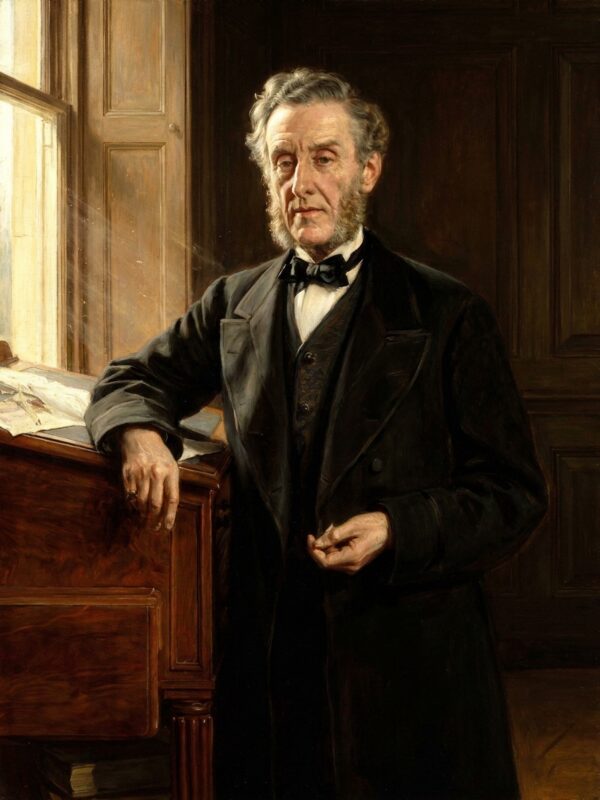
Lord Shaftesbury: Faith That Would Not Stay Inside a Church
Anthony Ashley-Cooper was born in London on April 28, 1801, into one of England’s old aristocratic families. He had every advantage except love. One biographer wrote that he grew up without any experience of parental love. His parents were distant and harsh, and he was sent away to boarding school at seven, a place he later remembered as full of horrors.
The warmth he did receive came from a family servant named Maria Millis. She read him the Bible and taught him to pray. She died when he was ten. But the Christ she pointed him to became the anchor of everything that followed. He later said that what she planted in him was the root of his entire public life. He became one of the leading evangelicals in the Church of England, shaped by a faith centred on Christ, His return, and the obligations that faith places on those with power.
He entered the House of Commons in 1826 and was known as Lord Ashley until his father’s death in 1851 made him the 7th Earl of Shaftesbury. His first great cause was the mentally ill. In 1827 he served on a committee on pauper lunatics and visited a private madhouse in Bethnal Green where patients were chained and kept in filth. His diary that night did not record the language of political calculation. He wrote that he hoped his first effort in Parliament had been, by God’s blessing, for the advance of human happiness. He saw human beings made in God’s image, stripped of dignity, locked away. That was enough to make it his business. He chaired the Lunacy Commission for decades. In 1845, the Lunacy Acts brought the mentally ill under a permanent commission he led, and the law began, slowly, to treat them as people deserving of care.
In 1833, he took over leadership of the factory reform movement. Children worked long hours in textile mills and underground in coal mines. He lost vote after vote. His resolution was defeated in 1837. His amendment was reversed in 1844. The Ten Hours Act finally passed in 1847, while he was temporarily out of the Commons. He was not fighting for credit. He gave thanks and kept going, because he believed the gospel had something to say about a child in a coal pit.
The climbing boys were his longest fight. Small boys were sent up narrow chimneys to clean them. The Act of 1840 banned the practice in London, but it was not enforced. Bills he introduced in 1851, 1853 and 1855 were defeated. The Act of 1875 finally required licensing of sweeps and police enforcement. Thirty-five years from the first law to the one that worked. He was in his seventies. The children could not advocate for themselves. He believed someone had to.
In 1844, he became president of the Ragged School Union, which gave poor children free schooling, often with food and clothing. About 300,000 children were educated through it. He also pushed the Lodging House Acts of 1851 and served as president of the British and Foreign Bible Society and the first president of the YMCA. He once wrote that every man holds his power in trust before God, and that trust has a reckoning. His faith was not a Sunday habit. It shaped what he read in the newspapers and what he did about it. He believed Christ was returning, and he did not want to be found idle.
He said that God had called him to work among the poor. That sentence is not a rhetorical ornament. It is the only explanation that fits sixty years of losing and returning.
He died at Folkestone on October 1, 1885, aged 84. He was offered burial in Westminster Abbey and chose the village church at Wimborne St Giles. His funeral service was held in the Abbey on October 8, and working-class Londoners lined the route. Charles Spurgeon called him the best man of the age. In 1893 the Shaftesbury Memorial Fountain was unveiled in Piccadilly Circus, with the statue the public calls Eros.
His memorial tablet carries no eulogy. Only his name, his dates, and three Bible verses he chose himself.
He was a politician who read his Bible and believed it. Every gift of power is held in trust before God. He spent his trust on the least of these.