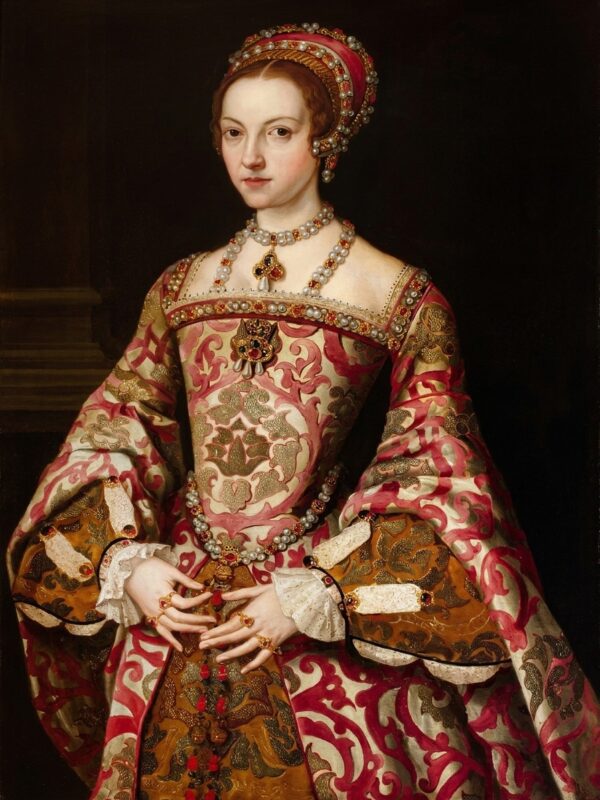
Anne Askew: She Named No One
Anne Askew was born around 1521 in South Kelsey, Lincolnshire, into a family with money and standing. Her father, Sir William Askew, was a gentleman in Henry VIII’s court. Anne was his fourth child. When her older sister Martha died before a planned wedding, Sir William decided to cut his losses and sent fifteen-year-old Anne to marry the man instead. The groom was Thomas Kyme, a Catholic. The marriage was not consulted about with Anne. It went ahead without her consent.
She brought something to that marriage that Thomas Kyme had not planned on: a mind that had already read the Greek New Testament and concluded that what the Church of Rome taught about the Eucharist was not what the Greek said. She kept reading after the wedding. She stopped going to confession. When Thomas Kyme told her to stop reading the Bible and return to the Church or leave the house, she refused. She returned to her maiden name and moved to London.
In London she preached. She met other Protestants. She studied. In March 1545 she was arrested under the Six Articles Act, which made denial of transubstantiation a capital offence. Edmund Bonner, Bishop of London, examined her for twelve days. She answered every question from Scripture. She was precise, specific, and legally careful. One scholar has noted that her real gift was her familiarity with English law, which she used to prevent a formal indictment. Bonner could not break her argument. She was released on bail. She went straight back to London and kept preaching.
In June 1546 she was arrested again. This time the people questioning her were not bishops. They were Thomas Wriothesley, the Lord Chancellor; Stephen Gardiner, Bishop of Winchester; John Dudley; and William Paget. The government had a theory: that Queen Katherine Parr, Henry VIII’s sixth wife, harboured Protestant sympathies, and that Anne Askew, who moved in those circles, could name the Queen’s ladies and confirm it. Anne was interrogated for two days. She gave no confession. She named no one. She was condemned as a heretic.
Then they took her to the Tower.
The rack in the lower room of the White Tower was shown to her. She was asked again for names. She refused. They stripped her to her shift, strapped her wrists and ankles to the rack, and turned the wheel. She fainted. They revived her and turned it again. The Lieutenant of the Tower, Anthony Knyvett, refused to continue and left the room to fetch a pardon from the king. Wriothesley and Sir Richard Rich continued turning the handles themselves. When it was over, her shoulders, hips, elbows, and knees had been dislocated. Her cries had been heard in the garden outside. She had given no names.
She was carried back to her cell. A sympathetic priest came to visit. She dictated to him a full account of her examination and torture. She wanted it written down. She was not done bearing witness.
The night before her execution, the offer came: recant and live. She refused. Her answer, preserved by John Foxe: “I came not hither to deny my Lord and Master.” Bishop Shaxton, a former Protestant who had recanted to save himself, came to her cell to urge her to do the same. She told him it would have been better for him if he had never been born. He preached against her at her execution the next morning.
On 16 July 1546, Anne Askew was carried to Smithfield in a chair because she could not walk. She was fastened to the stake by a chain around her middle and burned alongside John Lascelles, Nicholas Belenian, and John Adams. She was twenty-five years old.
John Foxe included her full account in Acts and Monuments, the Book of Martyrs, noting that her noble birth could have brought her wealth and comfort had she chosen them over Christ. Under Elizabeth I, that book was chained in every cathedral in England beside the Bible. Anne Askew’s examination and testimony was among the first pieces of prose written by an English woman. Queen Katherine Parr was never arrested.
Anne Askew had kept her mouth shut. It cost her everything. It may have saved the Queen’s life.
She named no one. She recanted nothing. She was twenty-five years old, and she knew exactly what she was choosing.