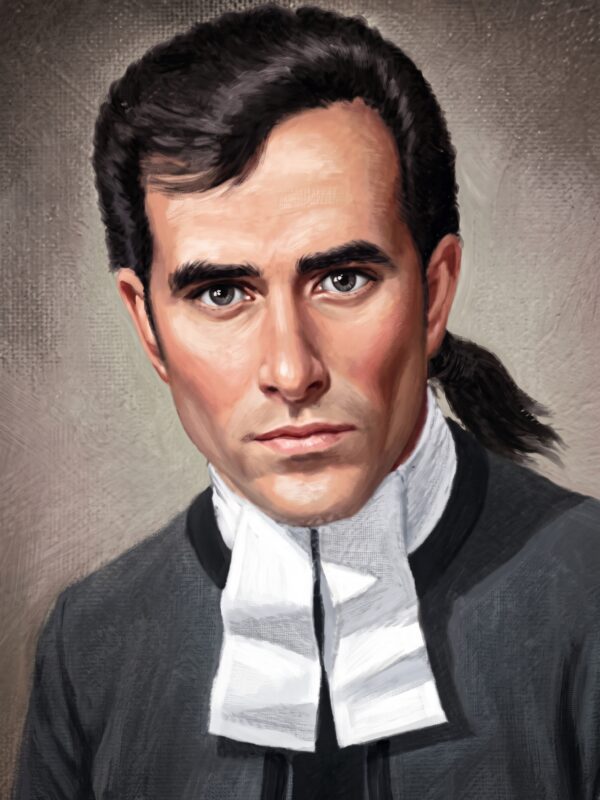
David Brainerd: God Used Him Exactly As He Was
Let me tell you about a man who had no business being a missionary.
He had been thrown out of Yale. He had no sponsoring denomination. He suffered from what we would today recognize as clinical depression – he wrote in his diary that he wished for his own death nearly two dozen times. And he was dying of tuberculosis from the day he arrived on the mission field.
David Brainerd was born in 1718 in Connecticut, the seventh of nine children. His father died when he was nine. His mother died when he was fourteen. He enrolled at Yale to study for ministry and was expelled in his third year for making a careless remark about one of his tutors. The remark was uncharitable but minor. The expulsion was permanent.
Without a degree, without a church, without an organization behind him, he found his way to a group of sympathetic pastors who licensed him to preach. A mission board in Scotland commissioned him to reach Native Americans. And in the spring of 1743, at age 24, David Brainerd rode into the American wilderness alone.
What followed over the next four years is one of the strangest and most quietly extraordinary stories in the history of Christian mission.
He rode through hundreds of miles of forest in Massachusetts, New York, Pennsylvania, and New Jersey. He often slept on the ground. He went weeks without seeing another Christian. His journals from those years are raw and honest in ways that most people of his era were not: he catalogues his depression, his physical deterioration, his stretches of spiritual darkness, his repeated conviction that he was worthless and that the work was hopeless. And then he records that he preached again.
In 1745, at a settlement called Crossweeksung in New Jersey, revival broke out among the Delaware Indians. Men and women who had never heard the gospel were weeping, crying out to God, being converted. By 1746, over 130 new believers were living in a functioning Christian community. Brainerd had been praying toward this for three years with almost nothing to show for it. When it came, he wept.
By late 1746 he was too ill to continue. He handed the mission to his brother John and rode away from the people he had given everything for. Jonathan Edwards later wrote: when he spoke of his congregation of Christian Indians in New Jersey, it was with such peculiar tenderness that his speech would be drowned in tears.
He died at Jonathan Edwards’s home on October 9, 1747, at the age of 29.
Two years later, Jonathan Edwards published Brainerd’s diary. It became one of the most widely read missionary documents in history. William Carey read it and went to India. Henry Martyn read it and went to Persia. David Livingstone kept it beside him throughout his years in Africa. Jim Elliot read it and went to Ecuador, writing his own journals in deliberate imitation of Brainerd’s.
None of them ever met him.
He was expelled, depressed, sick, alone, and dead before thirty. He spent four years in the wilderness with no visible result for three of them, a sudden revival for one, and a diary he never expected to matter.
It mattered more than he could possibly have known.
God did not wait for David Brainerd to be well before He used him. He used him exactly as he was. Broken, faithful, and going.