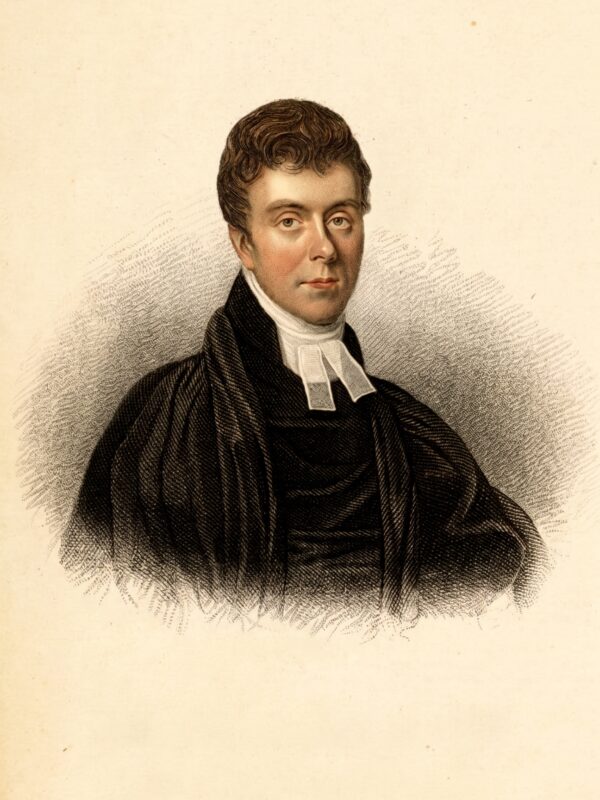
Henry Martyn: Let Me Burn Out for God
He was the best mathematician at Cambridge University. That was not a minor achievement in 1801. Cambridge’s Senior Wrangler prize was the most prestigious academic honour in England. Henry Martyn won it. He was elected a Fellow of St John’s College. Every door in the English establishment was open to him.
He chose India.
Henry Martyn was born in 1781 in Truro, Cornwall, the son of a merchant’s clerk. He arrived at Cambridge brilliant, ambitious, and largely indifferent to God. He won the Senior Wrangler prize in mathematics and seemed destined for a distinguished life in law or academia. Then his father died suddenly. In the grief that followed, he began reading his Bible seriously for the first time.
He came under the influence of Charles Simeon, the evangelical pastor of Holy Trinity Church in Cambridge. Simeon put the life and diary of David Brainerd in his hands. Martyn read it and was undone. He wrote: I felt my spirit greatly refreshed, and desired to imitate his example. He abandoned law, took holy orders, and signed on as a chaplain to the East India Company – the only available route to India for a man of his means and connections.
Before he sailed, he proposed marriage to a woman named Lydia Grenfell in Cornwall. She refused to go to India. He sailed anyway, in 1805, at the age of 24. He would write letters to Lydia from India for the rest of his life. They never married. He never saw her again.
In India, his tuberculosis began in earnest. The heat worsened it. He knew he was running out of time. He threw himself at the translation work with the urgency of a man who understood that urgency. He completed the New Testament in Urdu. He supervised an Arabic translation. He preached in Hindi. He debated Muslim and Hindu scholars with rigour and respect that his fellow British chaplains found baffling and his Indian interlocutors found disarming.
In 1810, his doctors ordered a sea voyage for his health. He used it to travel to Persia. He settled in Shiraz for almost a year, working with Persian scholars to revise and complete his Persian New Testament – the first since the fifth century. He presented it to the Shah of Persia through the British ambassador. The Shah wrote a letter of thanks praising its clarity. Martyn never knew. He had already left Persia on horseback, beginning the 1,500-mile journey home through Turkey.
He did not make it.
He died in Tokat, Turkey, on October 16, 1812, attended by Armenian Christians who buried him with the honors they reserved for their own bishops. He was 31 years old.
In six years of active ministry, he had translated the New Testament into Urdu, Persian, and Arabic. His Persian translation remained the standard for over a century. His journals were published after his death and have been called one of the most precious treasures of Anglican devotion. Missionaries still study his translation work and methods today.
He had said, in India, while the tuberculosis was taking him: Let me burn out for God.
He said it. He meant it. He did.
He left Cambridge with everything ahead of him and spent it all in six years on people who had never heard the gospel. He was 31 when he died. The Bible he left behind is still being read in languages that had never had it before he came.