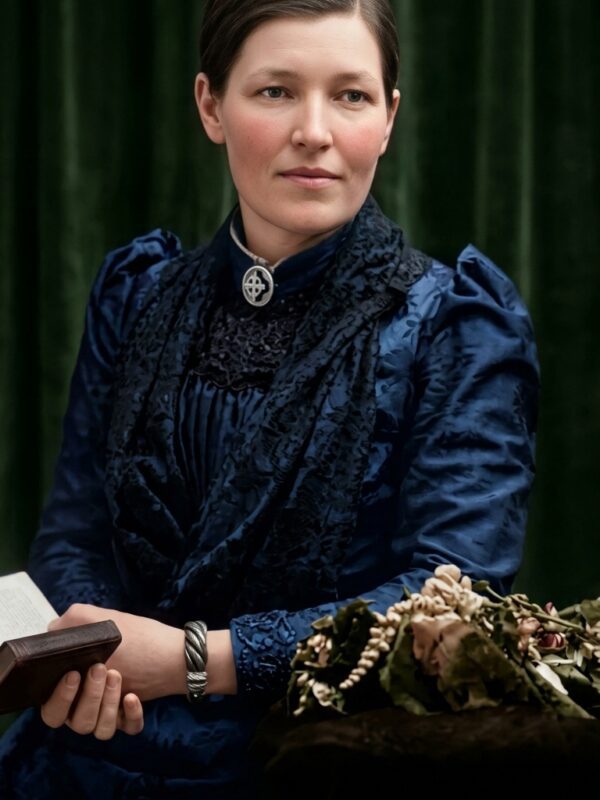
Mary Slessor: She Walked Into the Jungle Alone
She was barefoot most of the time.
That detail keeps coming up in every account of Mary Slessor’s life in Nigeria. Barefoot, walking through the jungle. Barefoot, sitting in court. Barefoot, carrying twin babies that nobody else would touch. She had come from the slums of Dundee and she had no interest in pretending she was someone else.
Mary Mitchell Slessor was born in Aberdeen, Scotland, on December 2, 1848, the daughter of a shoemaker whose drinking consumed what little money the family had. When Mary was 10, the family moved to Dundee, and at 11, she went to work in the linen mills to help keep her siblings fed. She worked 12-hour shifts. She propped a book open on the loom so she could read between operations. She educated herself in stolen moments on the mill floor.
What she read, over and over, were the missionary reports published by the United Presbyterian Church. She read about Africa. She read about David Livingstone. And she felt, growing stronger with every issue, that she was supposed to go there.
When David Livingstone died in 1874, something broke open in her. She applied to the mission board the following year. In 1876, at the age of 27, she sailed for Calabar, Nigeria.
What she found there was not what she expected, and she had not expected anything comfortable.
Slavery was everywhere in the port city. Witchcraft governed daily life. And in the villages inland, there was a practice that stopped her immediately: the killing of twin babies. The people of Calabar believed that one of every set of twins was fathered by an evil spirit. Since nobody could tell which one, both babies were killed or abandoned in clay pots in the bush. The mother was driven from the village in disgrace.
Mary decided she would end it.
She worked in the established missions near the coast for several years, learning the Efik language and building relationships. Unlike the other missionaries who maintained European habits and compounds, Mary moved into local housing, ate local food, and learned not just the language but the laws, customs, and social structures of the people around her. She was not there to impose. She was there to stay.
In 1888, she went further in than anyone had gone before, moving alone to live among the Okoyong people, a tribe known for violence and ritual killing that other missionaries had written off as too dangerous. Every European official told her it was suicide.
She went anyway.
She prayed: Lord, the task is impossible for me but not for Thee. Lead the way and I will follow. Why should I fear? I am on a Royal Mission. I am in the service of the King of Kings.
She built a simple home among the Okoyong and began the work. She walked into disputes between armed chiefs and talked them down. She stopped a human sacrifice by physically inserting herself into the proceedings and refusing to move. She collected abandoned twin babies from the jungle and filled her home with them. She adopted eight children formally, and cared for dozens more.
The Okoyong people began to trust her in a way they had never trusted any outsider. She became their advocate, their counsellor, their mother. In 1892, the British colonial government recognized what the Okoyong already knew and appointed her Vice-Consul in Okoyong, making her the first woman ever to serve as a British colonial magistrate. She presided over the native court, settled disputes, negotiated trade agreements, and continued her mission work, all while raising a houseful of Nigerian orphans.
She ran the court barefoot, with a child on her hip.
She fought the killing of twins for decades, one village at a time, one chief at a time. She carried twin babies on her journeys through the jungle. She trained local Christians to rescue twins in areas she could not reach herself. She was once found soaking wet, walking barefoot through heavy rain, carrying twin infants in both arms.
She eventually succeeded in having the practice declared unlawful by the local chief in her region. She did not live to see it ended everywhere. But she had bent the course of a culture that had held for centuries.
Mary Slessor died on January 13, 1915, in Use Ikot Oku, Calabar, at the age of 66. She had been in Nigeria for nearly 40 years. She had never retired to a comfortable home. She had malaria more times than anyone counted. She died in the place she had chosen to live.
The people of Calabar built statues of her. Every one of them shows her holding twin babies, one in each arm.
She had come from the worst of Dundee’s poverty. She had gone to the most dangerous corner of West Africa. She had become a tribal judge, a mother of orphans, and the woman who changed what twin babies meant in Calabar, Nigeria.
She told people: it is not Mary Slessor, but God and our united prayers that have brought the blessings to Calabar.
She did not go where it was safe. She went where she was needed. And where she was, nothing stayed the same.